
Test them, to better use them!
Ask a grower what the most important feature of their farm is, and you will get a wide range of answers. Many may say water access, location, rainfall frequency, or the family history. Regardless of whether you’re a hobby farmer with a few head of livestock, a large commercial livestock producer, hay producer, a cropper or even a seed company, the one vital feature of all these properties is the soil in which you produce your product.
With the current price of fertilizer and soil ameliorants such as lime, it’s important to know what exactly your soils need, so that you can get the greatest production out of them, with the most effective inputs possible. When used long term, soil tests can help assess the effectiveness of previous applications and be used to monitor any underlying issues such as sub soil acidity.
The best time of year for cropping paddocks and new pastures is to test post-harvest, so that your pre-sowing applications can be accurate and efficient for that soils needs. For permanent pastures, soil testing can be done across the year, however it is recommended that testing be done at the same time each year if you are planning to test annually. The usual pasture testing seasons are late summer/early autumn, and spring. Fixing issues or nutrient deficiencies in soils can take a long period of time, especially in permanent pastures (usually a few years before you see the full effect of an application!), so knowing how your soil is currently performing is important to make the decisions required to set your paddocks up for the next few years of production.
When sampling large paddocks, sample across a wide area, not just one or two points, as soil profiles can change across a paddock considerably. Take 5-10 cores for each sample, and mix before taking the sample that you send to the testing labs. Doing this gives you the average results for a paddock, however if the paddock has a range of different areas (such as a heavily wooded corner, a large dam or gully, and a high range), then take samples for each ‘area’ as they generally have different fertility results. Avoid sampling in areas of heavy traffic such as gateways and water troughs, tractor tram lines, or stock camp areas, as these locations are not representative of the whole paddock.
Soil sampling is an often overlooked tool when improving productivity in your paddock, so to make sure that you’re getting the best yield or biomass production you can, make sure you use test results to better allocate and select inputs this year.
Contact Lisa Miller lmiller@sfs.org.au or Tahlia Ferguson tferguson@sfs.org.au for further information on the soil testing projects SFS are currently involved in, or to discuss how best to undertake soil testing for your farm.
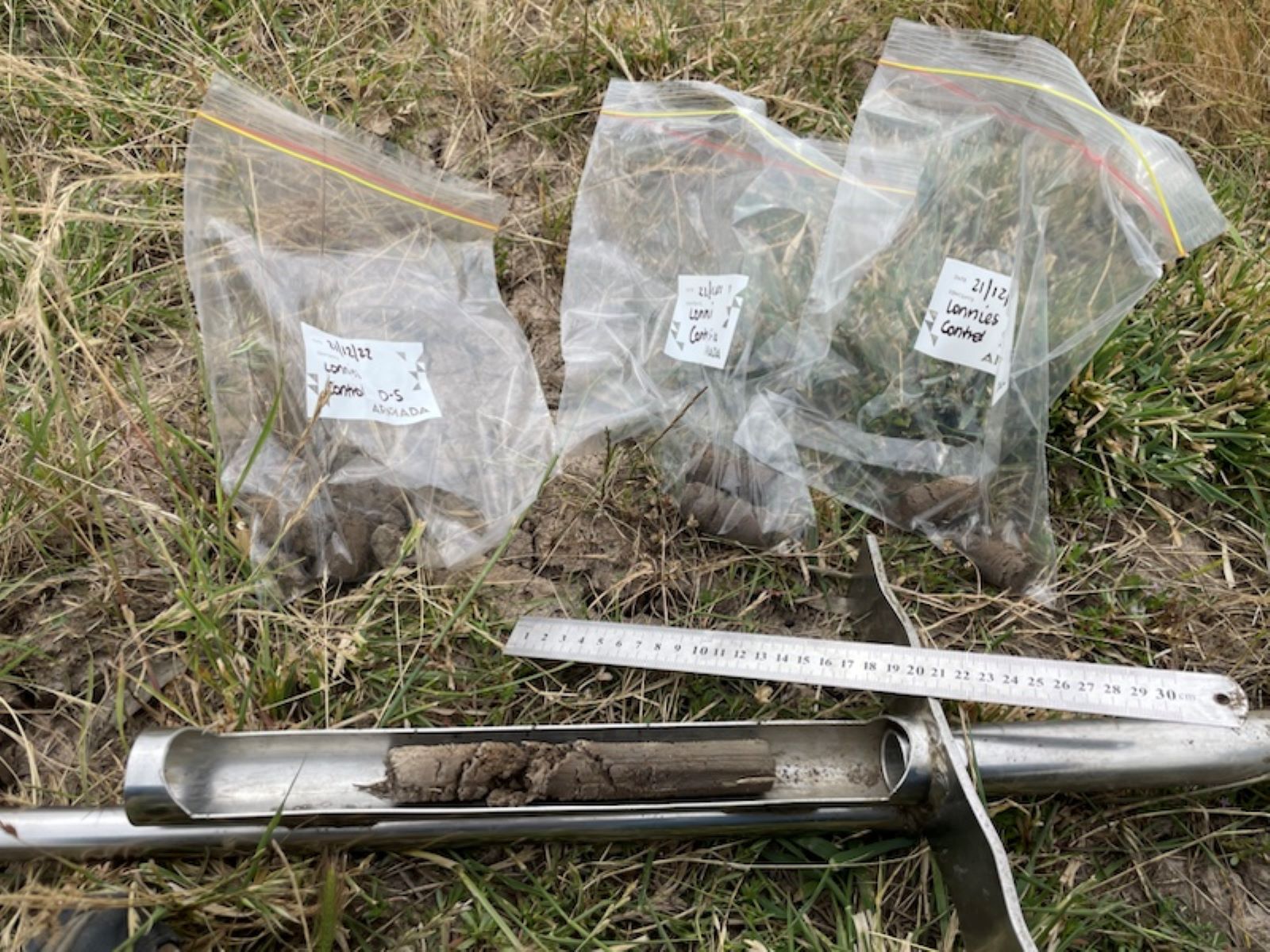
Image: Rokewood Soil Ameliorant trial testing using a hand corer, with sample collection bags according to depth.
Source: T. Ferguson. December 2022