SFS Highlights from the GRDC Grains Research Update – Bendigo 2026
Several members of the Southern Farming Systems team attended the GRDC Grains Research Update in Bendigo on 24–25 February 2026, joining growers, advisers and researchers from across the region to discuss the latest developments in grains research.
The event showcased new findings across a range of agronomic topics, with several presentations directly showcasing current SFS project findings and trial results.
A highlight of the update was the recognition of past SFS employee James Manson, who received the 2026 GRDC Emerging Leader Award for the southern region. The award recognises his significant contributions to the Australian grain industry, particularly his work in faba bean production and agronomy.
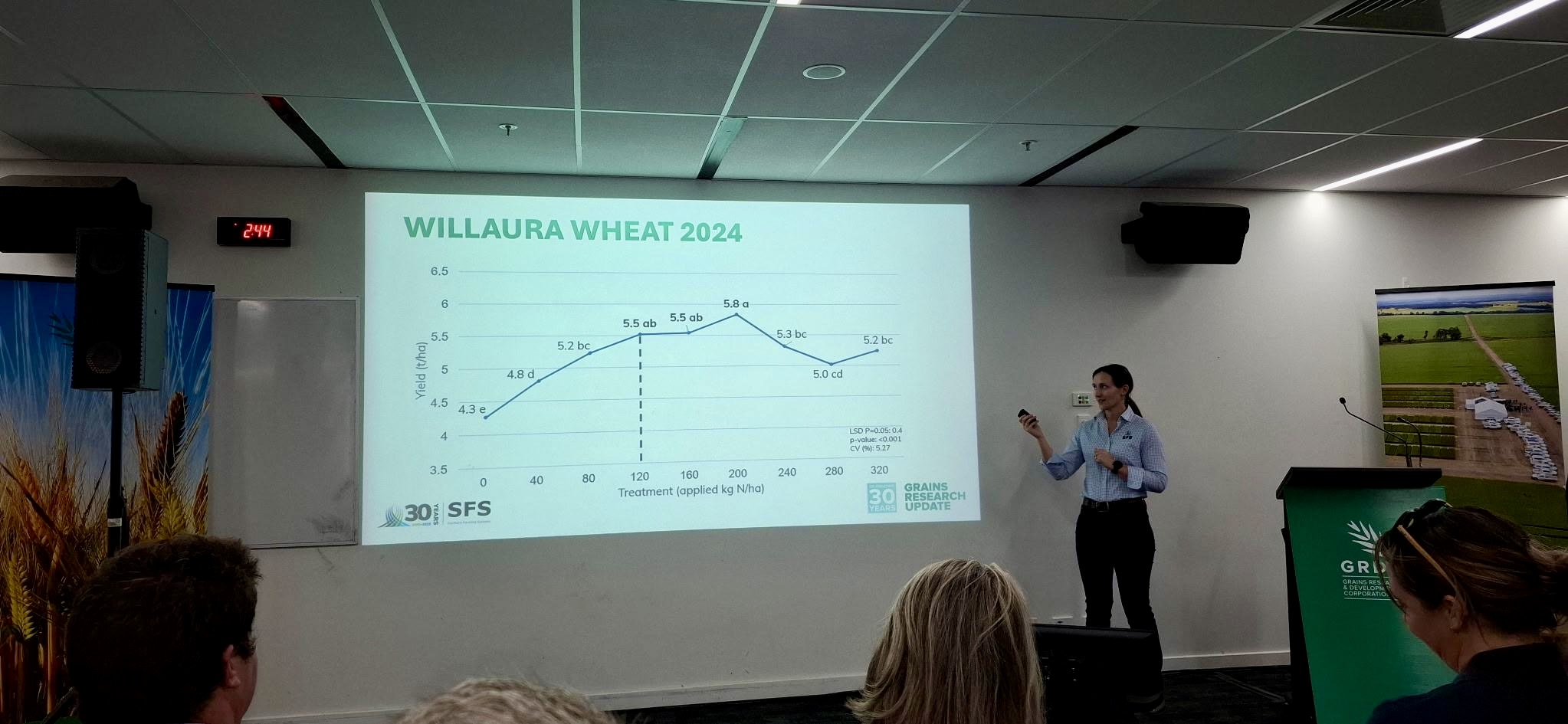
SFS research was also featured through the ‘Nitrogen use efficiency in the High Rainfall Zone’ project. SFS General Manager Ashley Amourgis presented the project findings on behalf of Greta Duff, Research and Extension Coordinator at SFS.
The project examines nitrogen (N) management strategies and crop responses across trial sites in the High Rainfall Zone.
Results from the Willaura wheat trial showed what researchers described as a typical nitrogen response curve. Wheat yield increased as nitrogen rates increased, with yield peaking at approximately 200 kg N/ha before declining and eventually plateauing at higher nitrogen application rates.
At the Streatham wheat yield curve trial, nitrogen had a different impact. In this case, nitrogen significantly influenced grain protein levels but did not significantly affect yield. This response was likely due to high starting nitrogen levels combined with seasonal stressors, including frost events and dry spring conditions.
The trial also investigated enhanced fertiliser products. While the results were not statistically significant, plots treated with Green Urea NV, an enhanced fertiliser containing a urease inhibitor, showed a trend toward retaining more nitrogen in the soil. This suggests potential for reduced nitrogen losses, although further research is needed.
Another presentation related to SFS was ‘Tracking profit and risk to cropping systems in the southern region – a preliminary scorecard’, part of the GRDC Farming Systems South (FSS) project, established in 2023.
Southern Farming Systems hosts one of the FSS trial sites at Streatham, contributing important regional data to the project. The initiative aims to better understand the drivers of profitability and sustainability in southern cropping systems by assessing strategies that improve performance metrics such as system gross margin and economic water use efficiency.
Preliminary results presented at the update indicated that the region’s baseline rotation of canola followed by wheat was the most profitable system when canola was sown early in April and followed by a winter wheat crop.
The second most profitable system involved an intercropping rotation of canola and field pea followed by wheat, which demonstrated a notable saving in nitrogen costs. These results are preliminary and ongoing research will continue to assess system performance.
Across the project, adaptive decision-making around variety selection, sowing time and crop end use was shown to improve gross margins, highlighting the value of flexible management strategies in southern cropping systems.