
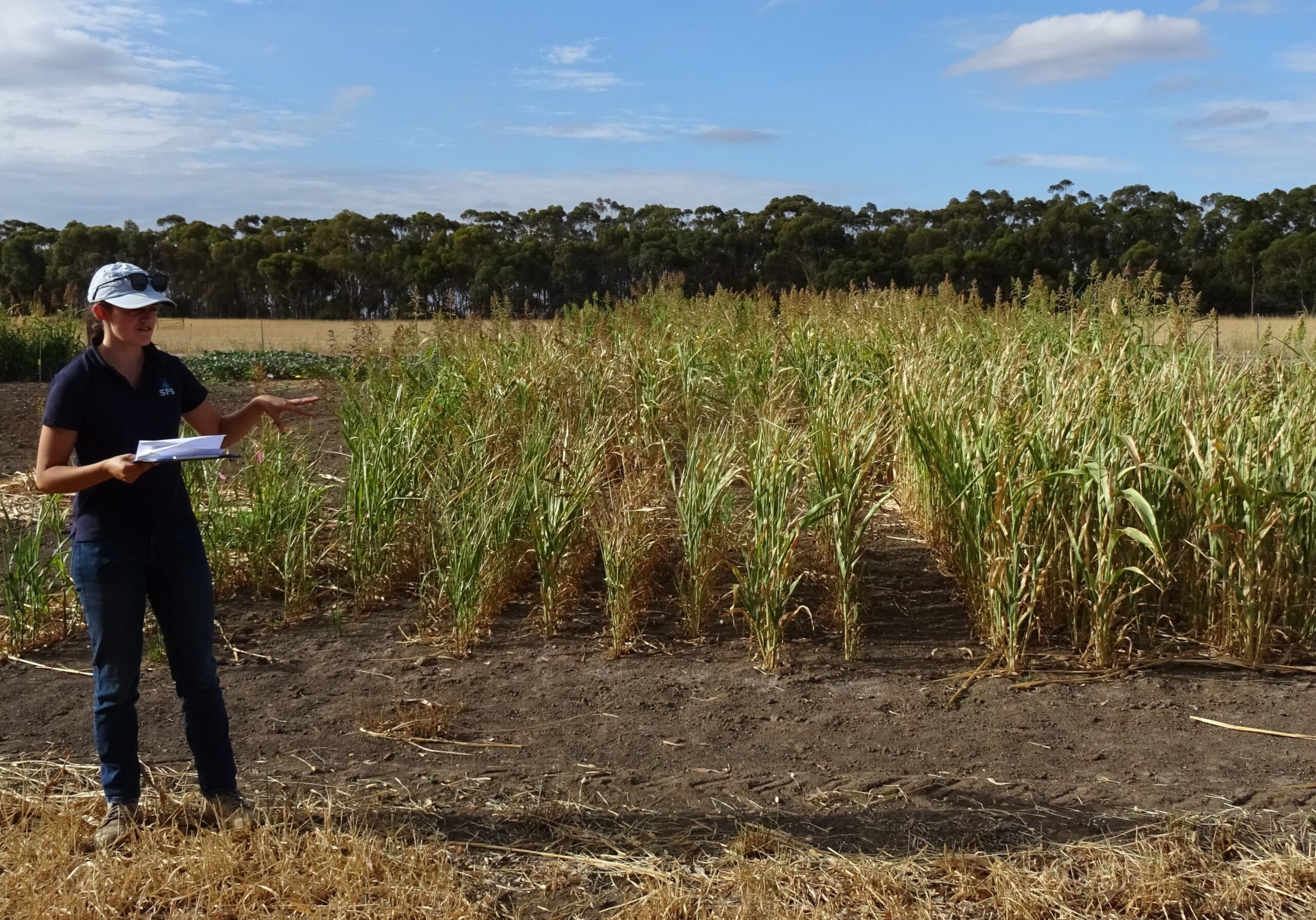
Summer Forage – Key Learnings
Key Learnings from the Rokewood Open Trial Site Inspection, 13 March 2024.
CleanCrop Management
The DLF CleanCrop technology demonstration with fodder turnips was on display. This package costs $150/ha and comes with Telar herbicide and herbicide resistant seed. The Telar herbicide active ingredient is Chlorsufuron (once marketed as Glean), this is registered on forty different weeds, of which many are those annoying summer weeds with long dormant seeds which makes them hard to control (e.g. fat hen, goosefoot and wire weed).
Key learnings from the demonstration:
- Seed sown in mid-October can sit there ungerminated until December rainfall and still have good establishment.
- Blackberry nightshade was one weed not affected by Telar that came up to compete with the turnips, otherwise the site sprayed with Telar was relatively weed free.
- In a season with crickets, baiting should have occurred in January and again in March, to reduce numbers before they lay eggs into ground softened by rainfall. Traditionally baiting occurs in February, however this season the crickets had burrowed into the turnip bulbs and feasted.
- Dry matter production of leaves and bulbs was about 4.3 t/ha, lower than 8t DM/ha which is considered good productive forage crop.
- Pests – Both crickets and white cabbage moth were in large numbers.
- Normally heat kills the cabbage moth, so they just kept breeding every 3 years with the mild January/February building up to plague proportions.
- Sheep actively seek out the bulbs.
- Decisions – The advantage of the CleanCrop turnips over a brassica is the bare weed free seedbed with no trash and no crop to terminate. However with Telar herbicide, there is plant back periods for clover sowing. So ideally, in year two you sow an annual ryegrass and sow perennial pasture in year three. Giving you the opportunity for further weed control, if needed.
Sorghum
The RAGT Sorghum trial investigated different varieties. Sorghum is a very impressive summer forage that needs high soil temperatures to grow. However, it contains Prussic acid which exists as two separate compounds that occur in different locations within the plant, when brought together in the rumen of livestock it can potentially form cyanide which is toxic/lethal to livestock, which dampens enthusiasm as a forage. A rule of thumb of when it is safe to graze is 80-90cm high, as the compounds become diluted through the plant. RAGT were keen to assess the levels and so plants were cut when they reached 50cm, 70cm, 90cm and 110cm.
Key learnings from the trial:
- Results from FeedTest indicate that levels were safe to graze at all the different cutting heights. But this was all in late January after good summer rainfall. However, it is possible that had cutting occurred in February when the plants had become water stressed, that toxic levels could have been detected. So, plant moisture stress might be a better guide than height, but best to use the 80cm to 90cm grazing rule and get plants tested.
- Prussic acid can be toxic, even when the Sorghum is cut for hay.
- Grow opportunistically in wet summers or if you have a shortage of hay.
- The varieties that contain Sudan grass contain less toxicity than sorghum or sweet sorghum breeds.
- Do not sow into dry soils. Do not panic, wait for rain before sowing. We sowed in October and the plants did not germinate until early December.
- The 4kg sowing rate had significantly less DM (5.5 t/ha) than 8 kg/ha and 12 kg/ha (8.5 t/ha) and was not an advantage with the good rainfall received over December and January.
Brassica’s
The RAGT Brassica trial investigated the effects of sowing rates on different varieties.
Key learnings:
- Visually, higher sowing rates produced taller plants with less leaves and branching. They grew tall rather than leafy.
- Exirel insecticide was used to control cabbage white butterfly because of its safety on beneficial insects.
By Lisa Miller, Specialist Research & Extension Officer