

Grazing Stubbles
As harvest is wrapping up for many, mixed farming producers may be looking to graze their winter crop stubbles. They can be a valuable source of feed, primarily from residual grain and green shoots from shot grain, weeds or green shoots from spring rains. The standing straw and trash will have a much lower feed quality (both energy and protein) which is below maintenance requirements for all classes of livestock. Therefore, animal weight gain is directly linked to the amount of grain and green material in the stubble.
Assessing the amount of grain/green
Research indicates there needs to be at least 40 kg/ha of residual grain or 40 kg/ha of green material for a sheep to maintain or gain weight. Below these values, animals lose weight, irrespective of how much straw or leaf trash remains. If either threshold is exceeded, livestock should continue to gain weight.
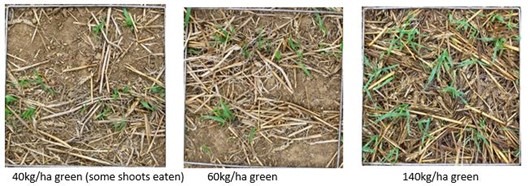
Table 1. below provides a simple guide to help assess the amount of grain in stubble, along with photos of different levels of green materials. It involves using a 0.1m2 (32x32cm) quadrat and counting the number of grains and green shoots.
| Table 1. Cereal grains and green shoot counts needed for kg per hectare. | |||
| Number of cereal grains/0.1m2 and approx. quantity of grain/ha | Number of cereal green shoots/0.1m2 and approx. quantity of green/ha as dry matter | ||
| Grains counted (number/0.1 m2) | Equivalent quantity of grain (kg/ha) | Green shoots counted
(number / 0.1m2) |
Equivalent quantity of DM (kg/ha) |
| 6 | 20 | 7 | 20 |
| 13 | 40 | 14 | 40 |
| 20 | 60 | 21 | 60 |
| 26 | 80 | 28 | 80 |
The equivalent of 40kg/ha for crop legumes is approximately four grains per quadrat for lupins, two for field peas and chickpeas and one for faba beans.
Photo 1. Indication of green shoot material available for grazing.
Variation in stubble value
The value of stubble can vary greatly between crop types and grain vs green (Table 2). Always compare the feed value to the sheep’s minimum daily requirements (e.g. a 50kg adult dry sheep required 7 MJ ME per day and 6% crude protein).
The best way to determine feed quality is with a feed test. However, it can be difficult to measure accurately due to the variability across paddocks and to obtain a sample of what animals are eating.
Table 2. Feed value of common stubbles/grains (Grain and Graze).
| Wheat and barley stubble | Oats | ||||
| Feed value | Grain | Green | Straw | Grain | Loose trash |
| Dry matter digestibility (%) | 82–87 | 59–73 | 38–40 | – | 40–41 |
| Metabolisable energy (MJ / kg DM) |
12.7–13.2 | 8.5–11.0 | 5.0–5.3 | 9.0–11.0 | 5.3 |
| Crude protein (%) | 9.5–13.5 | 15.9–18.7 | 1.2–2.8 | 6.0–12.0 | 2.0–4.0 |
Supplementary feeding
Supplementary feeding can extend the grazing time of stubbles by helping sheep reduce weight loss as stubbles become depleted and increase the utilisation of low-quality stubble forage.
Providing high protein supplements such as lupins or peas will help sheep meet their protein requirements when grazing cereal stubbles.
Table 3 shows the nutritional value of a range of supplementary feeds in comparison to sheep requirements (Grazing modern stubbles, MLA).
| Feed | Metabolisable energy (MJ/kg) | Crude protein (%) | Fibre (% ADF) | |
| Grain | Wheat | 13 | 11 | 3 |
| Barley | 12 | 11 | 8 | |
| Oats | 11 | 9 | 18 | |
| Lupins | 14 | 38 | 20 | |
| Canola | 16 | 22 | 24 | |
| Hay | Cereal | 9 | 9 | 29 |
| Pasture – early cut | 10 | 14 | 28 | |
| Pasture – late cut | 9 | 10 | 32 | |
| Chaff (Excl. main stems and grains) | Wheat | 6.0 | 4.5 | 45 |
| Barley | 6.3 | 5.5 | 42 | |
| Lupins | 7.0 | 6.5 | 42 | |
| Canola | 6.0 | 5.0 | 47 | |
| Sheep requirements (for maintenance) | Dry adult ewes | 7.1-8.0* | 8 | ~15 |
| Mid pregnancy (100 days) – single | 9.9** | 10 | ~15 | |
| Mid pregnancy (100 days) – twin | 11.1** | 11 | ~15 | |
| Weaners (20kg) growing at 50g*** | 6.5-7.5 | 11-13 | ~15 | |
* Lower value condition score two, higher value condition score three.
** Condition score three ewes.
*** Minimum acceptable rate of growth for 20kg animals.
When to graze?
The best time to graze is straight after harvest as the feed quality will decrease over time.
Stock should be removed once grain and green shoots fall below 40 kg/ha. Grazing should be conducted to retain between 50% and 70% groundcover to avoid wind erosion or decrease water infiltration.
Grazing duration
The grazing duration of a paddock varies widely due to numerous factors:
- Crop type
- Summer rain
- Growing season conditions (crop yields, frosts)
- Stocking rate
- Harvesting conditions (header grain losses)
- Weed burden
- Paddock conditions
However, Agriculture Victoria’s general guide, stock should be removed from the stubble paddock after 6 weeks.
Additional information:
Sheep nutritional requirements when grazing stubbles – Agriculture Victoria
Five tips for grazing sheep on stubbles – MLA
Grazing modern stubbles – MLA