

Good thing plants don’t have panic attacks!
It’s been a stressful year! And I’m not just referring to my interstate shift. Stress events in farming are part and parcel of the job. Cracking frosts, scorching heat, and raging winds are some of the big events we remember and talk about. Then there are the long-term stressors, for example not enough water, or too much water. With all these big stress events it’s easy to overlook the mild and moderate stressors that occur throughout the season. How much stress have the crops undergone this growing season in the High Rainfall Zone?
Since the start of the growing season in April there have been 338 stress events over the 5 main SFS trial site areas. The stress events are mild, moderate and severe frosts, wind and rain events. Heat stress events have not occurred yet in this growing season and have not been included, but are a risk for Victorian farmers during flowering and grain fill. Figure 1 shows how these events are spread throughout the season to date.
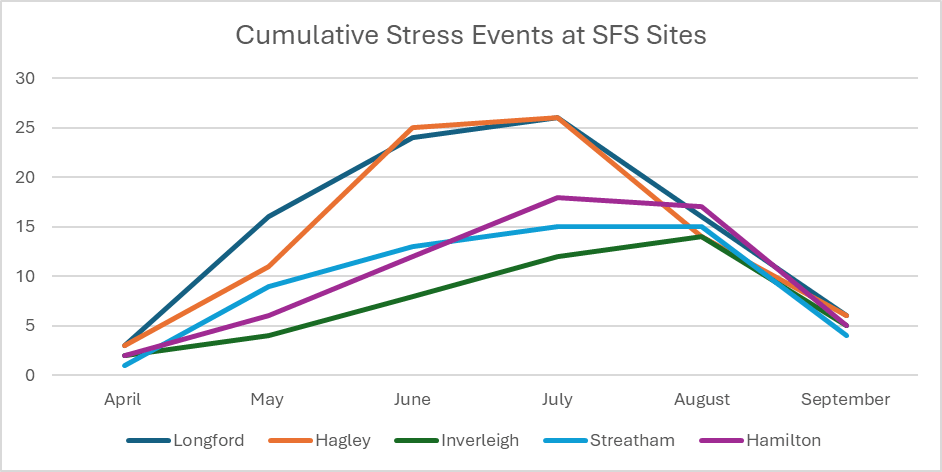
My Farm Dashboard can provide users with data on stress events sourced for their location pooling data sources from CSIRO, SILO and Bureau of Meteorology. The dashboard calculates stress events based on temperature fluctuations.
The frost events are categorised as:
Mild Frost: minimum temperature between 0°C and 2°C
Moderate Frost: minimum temperature between 0°C and -2°C
Severe Frost: minimum temperature less than -2°C
These categorisations occur when temperatures reach the described levels, but do not consider the duration that the temperatures remain at these levels, essentially the lowest temperature for the day. At any of these temperature levels a 1-to-2-hour frost will have a vastly different impact than a 12+ hour frost. For more information about the impact of frost in farming check out the Better Frost Decision work on our website, https://sfs.org.au/project/better-frost-decisions.
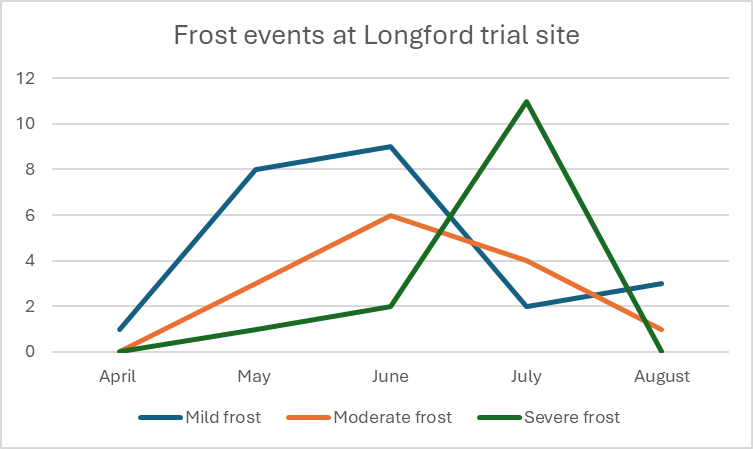
The Longford trial site in Tasmania has had the most frost events this growing season with 51 total frost days. The timing of each type of frost event can be seen in Figure 2, as the season progresses through winter the incidence of mild and moderate frosts reduces, and the severe frosts increase.
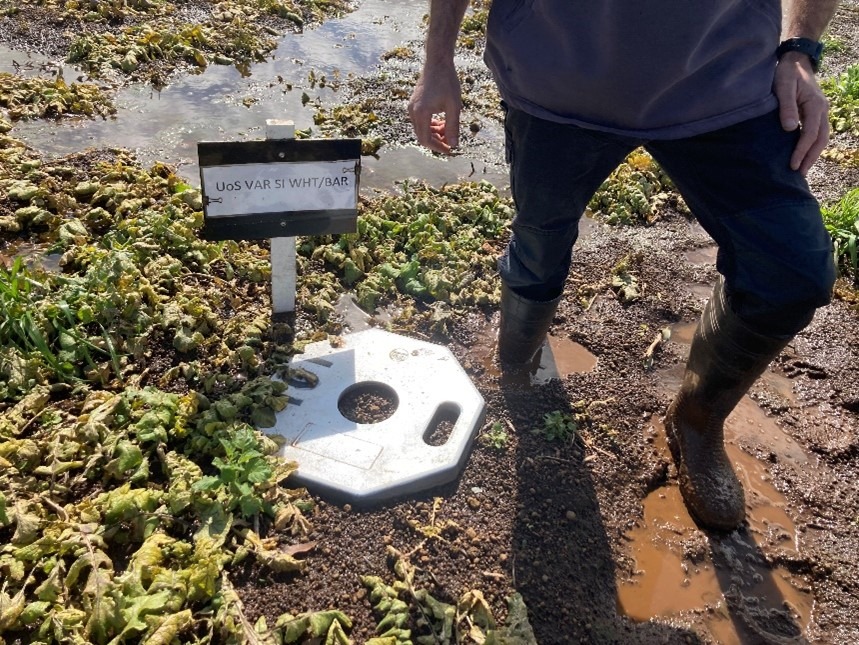
Wind events have become a significant concern in Tasmania, with wind speeds reaching 130 km/hr at Launceston Airport on 1 September, according to the Bureau of Meteorology (BOM). The state experienced extensive damage, including overturned pivots, thousands of fallen trees, and widespread power outages. A site visit to the Hagley trial site after the storms revealed lodging in some trial plots, attributed to root lodging. As little as 6mm of rain in a day can weaken the soil surface strength, increasing the risk of root lodging (Agriculture and Horticulture Development Board UK, 2024). Combined with strong winds, it was unsurprising to find lodging in the affected areas. Figure 3 demonstrates just how soft the ground had become.
Wind events at the SFS trial sites were assessed in four categories:
Winds greater than 50km/hr, with and without rain
Winds greater than 100km/hr, with and without rain
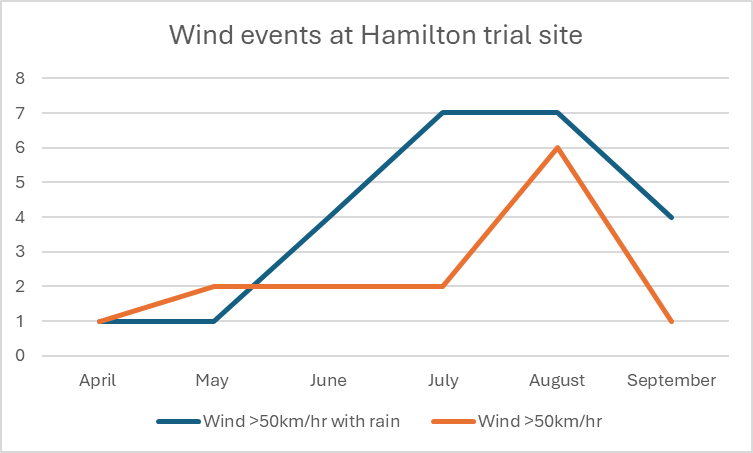
The Hamilton trial site experienced the highest number of wind events, with 52 days recording wind speeds exceeding 50 km/hr, as illustrated in Figure 4. Although these were not the strongest winds, they were frequent. According to the University of California (2024), plant damage can occur in winds above 30 miles per hour (48 km/hr).
We are 153 days into the growing season for 2024, (growing season of 1-Apr -13-Sep) and the SFS trial sites have seen many stress events. Table 1. shows that most of the SFS trial sites have spent over a third of their season in some kind of stress.
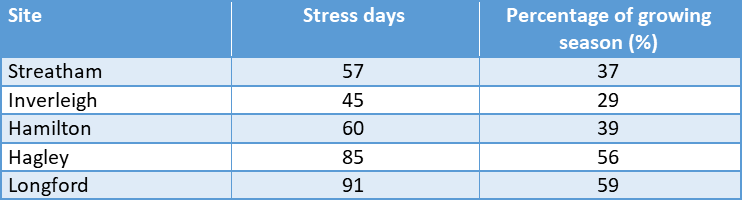 Table 1. Stress days and the percentage of the growing season spent in stress across all SFS trial sites.
Despite the number of stress events to date, there has been minimal impact on potential yield as the resilient plants are in growth stages that aren’t strongly related to yield and they have the opportunity under the right conditions to grow out or compensate. Caution still needs to be shown when we have the extreme’s. Therefore, it is a good thing plant’s don’t have panic attacks!
Crops are now moving into the danger zone of the later growth stages of flowering, podding, grain fill, this is where these stresses can have direct yield impact that is out of our control.
Written by Grace Evans, SFS Senior Research & Extension Officer